§ guides
Last updated September 23, 2026Tattoo booking software: what it costs and what actually matters
Consultations, sessions, deposits, and a portfolio that's actually yours.
Most booking software treats a tattoo artist as an edge case: a calendar built for haircuts, with a card reader bolted on, and no idea what a consultation is or why a session might run six hours. Tattoo-specific tools go the other way and charge for a shop's worth of paperwork whether you rent one chair or run six stations. CNL Systems is $29 a month, flat, one plan, with your own site on your own domain and no cut of what you charge for a sitting.
That is the pitch. Here is what the rest of the market actually charges, and what a tattoo artist actually needs from the thing that runs their book.
What does a tattoo artist actually need from booking software?
Strip the feature grid down to the trade and the list is short, and it looks nothing like a salon's. You need two different kinds of appointment, not one. A consultation is short, often free, and exists to talk through placement, size, and reference before anyone commits to a date. A session is long, sometimes half a day, and the calendar has to block real hours for it, not a fifteen-minute default built for a blowout. You need a deposit that actually holds the date, because a custom piece drawn to your client's specs is time you cannot resell if they no-show. You need a piece that spans several sittings to still read as one client relationship, not three unrelated bookings. And you need somewhere your work lives that is actually yours, because tattoo work is the most portfolio-dependent trade on this site, and the DMs need to stop being where your business runs.
None of that is exotic, but it is not what a feature grid built for a hair salon gives by default, and it is not what a tool priced for a six-artist shop lets you pay for at one-artist rates.
What do tattoo-specific booking apps cost?
One name comes up most when a tattoo artist searches for booking software built for the trade instead of adapted to it: Porter.
| Platform | Plan | Price | Priced for |
|---|---|---|---|
| Porter | Artist Essentials | $35/mo | One artist |
| Porter | Artist Pro | $65/mo | One artist |
| Porter | Studio Pro | $250/mo | Unlimited artists, commission splits, 1099s |
| CNL Systems | Solo | $29/mo flat | One artist, with your own site, deposits, and online and in-person payments included, no cut |
Porter's Artist Essentials sits above CNL at $35 a month for the same one-artist job, and Artist Pro reaches $65 a month, more than double CNL's flat rate. Both of those are still single-artist plans; the multi-artist tier, Studio Pro, is $250 a month.
CNL does not have automated waivers or consent forms inside the booking sequence today. We hold the date and take the deposit; the paperwork is still yours to run however your shop already runs it. If that workflow is what you actually need, it is better to know the gap now than find it on your first booking.
What Porter is really built to sell, past the calendar, is a shop rather than a chair. Its ceiling is Studio Pro at $250 a month for unlimited artists, commission splits and 1099s, which says plainly who it is priced for. One artist in a private studio or a rented chair is buying the entry tier of something built to grow into a business they may never run.
What does a tattoo-sized deposit actually protect against?
The dollar math matters more here than almost anywhere else on this site, because the ticket sizes are bigger and the time is harder to resell. A haircut that no-shows costs you forty-five minutes. A custom half-sleeve session that no-shows costs you an afternoon you turned other work away for, on a piece nobody else can book because it was drawn for one person. A deposit at booking is not a courtesy fee in this trade. It is the only thing standing between a drawn design and a wasted day.
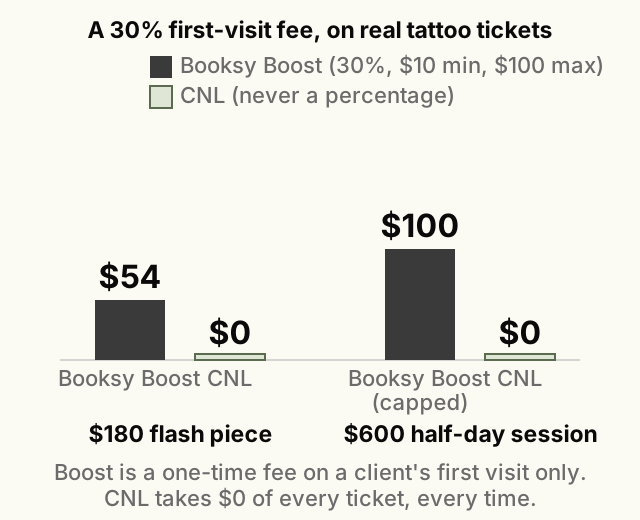
Run it on real numbers. Booksy's Boost, its marketplace promotion, takes a one-time 30% commission on a new client's first visit, with a $10 minimum and a $100 maximum, and nothing owed after that. On a $180 flash piece, that is $54 gone before you pick up the machine. On a $600 half-day session, a real number for a mid-size custom piece, 30% would be $180, but Boost's own $100 maximum caps the fee there instead. Whether the trade is worth it depends on whether Boost brought a client you would not otherwise have found, and on tickets this size, even the capped fee is not a rounding error.
The deposit itself, on CNL, is set by you, service by service. There is no CNL rule for what it has to be or when it is refundable. A no-refund-on-cancellation policy, a common norm in tattoo work because the design time already happened, is yours to set and enforce. CNL's part is making sure the slot is not created as a real appointment until the deposit clears, and that the full amount lands in your account with nothing taken off the top.
How does a multi-session piece actually get booked?
A sleeve or a large back piece is not one appointment. It is a consultation, then a series of sessions against the same client, sometimes months apart.
On CNL that is the natural shape of services that already carry their own duration and price, not a separate feature to configure. A consultation is a short service, priced at zero or a token amount, that gets the placement and reference sorted before anyone commits to a date. Each session afterward is its own service, with whatever block of hours it needs, four, six, a full day, and whatever deposit holds it. The calendar refuses to double-book any of them, because two appointments cannot occupy the same minute of your chair.
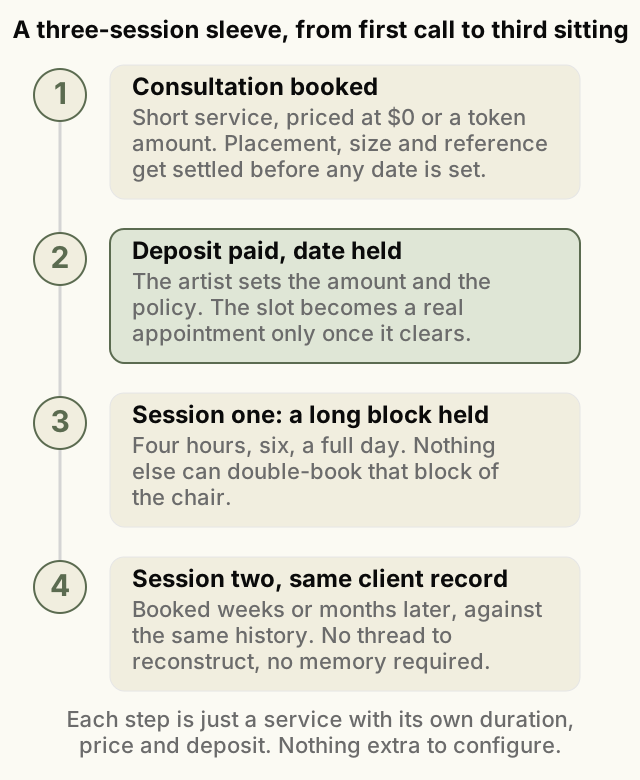
What ties the sessions together is the client record underneath them. Every booking against the same person lands on the same history, so when they come back in October for session two of a piece you started in July, you are looking at one client with a full record, not reconstructing the plan from a text thread. Automatic reminders go out for each session, and the reschedule link inside them respects your rules, so a session that has to move does not turn into another DM thread.
Why does a tattoo artist need their own website more than almost anyone?
Because the work is visual and travels by referral, and where it lands when it travels is the entire question. A client shows a friend the piece you finished. The friend asks who did it and types your name into Instagram or a search bar. If that resolves to a marketplace profile, they land next to nine other artists in a "similar professionals" rail, on a platform actively selling their attention to whoever else pays for it. If it resolves to your own domain, the only artist on the page is you.
That is what a Gallery page is actually for on a CNL site: a page you turn on with your own images, in your own order, at your own address and nowhere else. Turn it off between good photos to show and it comes back later with everything still in it, with nothing depending on a directory listing you do not control.
What do the general booking platforms cost, and where do they fall short for this specific trade?
Square, Vagaro and Booksy are not built for tattoo work, but a lot of solo artists land there anyway because the name is familiar. Square's calendar is funded by its processing business rather than a subscription, which puts it in a different pricing shape from the other two. Here is what Vagaro and Booksy actually cost, checked against their own pricing pages today.
| Platform | Entry price | Website on your own domain | Cut of a client |
|---|---|---|---|
| Vagaro | $23.99/mo promotional, $30/mo list, per calendar | Paid add-on, $20/mo (MySite) | None |
| Booksy | $29.99/mo + tax, plus $20/mo per extra team member | No; marketplace profile only | 30% one-time fee on a Boost client's first visit, $10 minimum, $100 maximum |
| CNL Systems | $29/mo flat, one plan | Yes, included | None |
Square's booking page comes included as a Square-hosted page rather than your own domain, and the trade is a booking page built to feed Square's own payments business, not a site built to be your studio's front door. Vagaro's pricing page lists the calendar subscription and its per-calendar add-on, $10 for each additional bookable calendar up to seven, but no website is folded into that number; its site builder, MySite, is a separate product at $20 a month on top of the calendar. Booksy charges no percentage on repeat clients, but every new client books through a marketplace profile next to whoever else Booksy is promoting nearby, and the 30% Boost fee on a first visit moves with your ticket size, floored at $10 and capped at $100, instead of staying flat.
None of the three were built around a consultation-then-session structure, the two-appointment shape a tattoo artist actually needs. They are general scheduling software that also happens to take an appointment for a tattoo, the same way it takes one for a manicure.
What does CNL actually include, and what is it not?
$29 a month, one plan, everything in it: your own site on your own domain, a Gallery page for your portfolio, online booking with deposits set service by service, payments online and at the chair, automatic reminders, your client history, and email campaigns for the slow weeks. We never take a percentage of what you charge. Card processing runs at Stripe's standard rates with no CNL markup, so the rate you pay is Stripe's rate, not Stripe's rate plus ours. An optional Stripe WisePOS E for the studio is $249 once, bought direct from Stripe at Stripe's price; we do not resell it, mark it up, or touch the payment. The domain itself is registered for you at cost, about $12 a year for a .com, or connect one you already own for free, and if you ever leave, the full client export leaves with you, history and notes included.
What is not in it, plainly: no automated liability waivers or consent forms in the booking flow, no commission-split or staff-rota tools for a multi-artist shop, no shrinkage or inventory tracking for a retail wall. CNL is built for one artist running their own book, private studio or rented chair. If compliance paperwork or shop-wide staff management is what you actually need, that is a real gap, and you should know it before you sign up.
The short version
Tattoo-specific tools charge more for one artist than CNL's flat $29: Porter's entry plan is $35 a month and its next tier is $65 a month, both priced for a single artist. General booking platforms charge a different way: Booksy's Boost keeps 30% of a new client's first visit, floored at $10 and capped at $100, and Vagaro sells its website builder, MySite, as a separate $20-a-month product on top of the calendar it already charges for.
CNL is $29 a month, flat, with your own site, your own domain, a portfolio page that is actually yours, deposits that hold a real date for a real block of hours, and no cut of what you charge. It will not fill out a consent form for you. It will stop the DM thread, hold the date, and take the payment, which for one artist running their own chair is the job that actually needed solving.
Competitor prices, plans and fees on this page were verified at each company's own pricing page on September 23, 2026. Prices move; check them before you sign anything, including ours.
Related guides
Salon website builder
Which booking platforms give you a real website on your own domain, which give you a page on theirs, and what each one charges for it.
Booksy alternative
Booksy's marketplace works both ways. Every client who opens it to book you is browsing your competitors, and CNL puts your book on your own address.
Vagaro alternative
Vagaro sells the calendar, then sells you everything around it separately. At CNL the website is the product and $29 is the whole bill.
Square Appointments alternative
Square Appointments exists to feed Square's checkout stack, and every booking page lives at a square.site address. CNL builds yours on your own domain.
What booking apps cost
Booksy, GlossGenius, Vagaro, Square and CNL side by side, with every figure taken from the vendor's own published pages and dated.
Lash and brow booking software
What GlossGenius, Booksy, Vagaro and Fresha actually charge a solo lash or brow artist, and why a two-to-three-hour full set on a fourteen-day fill cycle needs different protection than a haircut.
Quick answers
What is the best booking software for a tattoo artist?
How much does tattoo-specific booking software cost?
Does CNL include consent forms or liability waivers?
How does Booksy's Boost fee work for a tattoo artist?
Can a tattoo artist book a multi-session piece on CNL?
Why does a tattoo artist need their own website instead of a marketplace profile?
One plan. Your domain. Live tomorrow.
$29/mo flat, everything included, and we never take a cut of your sales.
No cut of your sales · cancel anytime