§ guides
Last updated September 23, 2026Salon software for booth renters: why the owner's system isn't yours
You rent the chair. You shouldn't have to rent your client list too.
If you rent a chair, a booth, or a suite, you are already running your own business. You just happen to run it inside somebody else's building. That distinction matters more than most booth renters treat it, because the easiest software decision, using whatever the salon owner already has running at the front desk, is usually the one that quietly hands your business back to the landlord. CNL Systems is $29 a month, flat, on your own domain, with no cut of your sales, built for exactly one person running their own book. Here is what renting your book on someone else's software actually costs, and what it costs to keep it yours.
What does a booth renter actually need from booking software?
Strip the feature grid down to what a renter, not a shop, actually touches. You need clients to find you and book without a text thread. You need a deposit to hold the slot, because an empty chair on a Tuesday afternoon is money you cannot get back. You need reminders so people show up. You need the payment to land in an account with your name on it, not a house account you draw against later. And you need the list of who those clients are to stay with you when you move chairs, because moving chairs is something booth renters do.
Everything past that, staff schedules, commission splits, shift coverage, a shared front-desk register, is a shop owner's problem. If you are the one paying for a seat, you should not also be paying for the software that manages seats you do not own.
Why the salon owner's software was never yours to take with you
Most salons that host booth renters already run something like Vagaro, Booksy, GlossGenius, or Square Appointments for the whole location. It is tempting to just get added as a calendar inside that account. It is also the version of this decision that costs you the most in the long run, and it is not really about money.
When you book through the owner's account, the client's contact information, their visit history, and the calendar itself belong to that account, not to a login you control. Vagaro, for instance, prices exactly this structure: a business adds a bookable calendar for each additional person at roughly $10 a month, on top of the owner's own subscription. Booksy does the same thing at $20 a month per added team member. Either way, you are a line item on someone else's bill, and the account that holds your client relationships is the one the salon keeps when you leave.
That is the part worth sitting with. A renter who built two years of repeat clients inside the shop's shared system does not walk out with a client list. They walk out with a phone full of names and no record of who last saw them, what they usually book, or how to reach the ones who do not save your new number. The booking system was never yours. You were a tenant inside it the same way you were a tenant in the room.
What do booth renters pay for booking software right now?
Here is what it costs to run your own account, separate from the salon's, at each vendor's own published price today.
| Platform | Entry price | Website on your own domain | Cut of a new client |
|---|---|---|---|
| Booksy | $29.99/mo + tax, plus $20/mo per added team member | No | 30% of a first Boost visit, $10 floor, $100 cap |
| GlossGenius | $28/mo month-to-month, $24/mo billed annually (Standard) | No, forwarding only | None |
| Vagaro | $30/mo list, $23.99/mo for the first six months | Paid add-on, $20/mo (MySite) | None |
| CNL Systems | $29/mo flat, one plan | Yes, included | None |
The subscription prices sit close enough together to be noise. What is not noise is the last two columns, and the fee structures underneath the entry price.
Is Booksy's Boost fee worth it on a renter's ticket?
Booksy's own support documentation is specific about this, so run it on real renter tickets instead of an average. Boost, the marketplace promotion that puts your profile in front of new searchers, takes 30% of a first-time client's visit, with a $10 minimum commission and a $100 maximum, and nothing further on repeat visits from that same client.
Do that math on the tickets a booth renter actually writes. A $30 haircut clears 30% at nine dollars, so the $10 floor takes over and the effective rate becomes a third of the ticket. A $40 nail fill lands at $12. A $150 color service comes to $45. A $350 microblading or extension package hits the ceiling: 30% would be $105, so Booksy caps it at $100, which is still 28.6% of the visit. There is no ticket size where this fee is small.
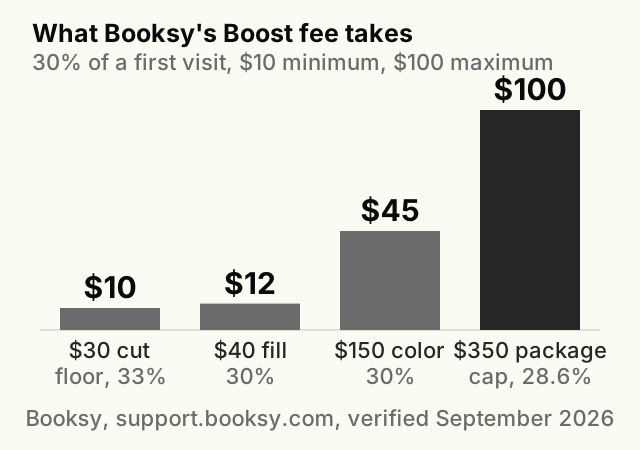
Boost charges once for putting your profile in front of someone who was not already looking for you. Whether it is worth turning on depends entirely on whether that client would have found you anyway, through the same social post or referral that would have cost you nothing. For a renter building a personal client base rather than feeding a shop's front door, a fee that takes a third of a $30 ticket is a hard number to make work.
Do you get your own website, or a profile inside someone else's?
This is where the market splits, and it splits harder for a renter than for a salon owner, because a renter has no storefront. Your website is the only address you have.
GlossGenius says this plainly in its own help documentation: connecting a domain you already own works by domain forwarding through your registrar, and GlossGenius does not supply the DNS records a real custom domain needs. Type in your name and the address bar still resolves through glossgenius.com. That is a forward, not an address of your own.
Vagaro sells the actual thing, a website builder called MySite, but as a separate line: $20 a month on top of whatever calendar plan you are already paying for. Add that to the $30 list price for one calendar and getting a real site costs $50 a month before you have booked a single client, or $43.99 for the first six months at the promotional calendar rate.
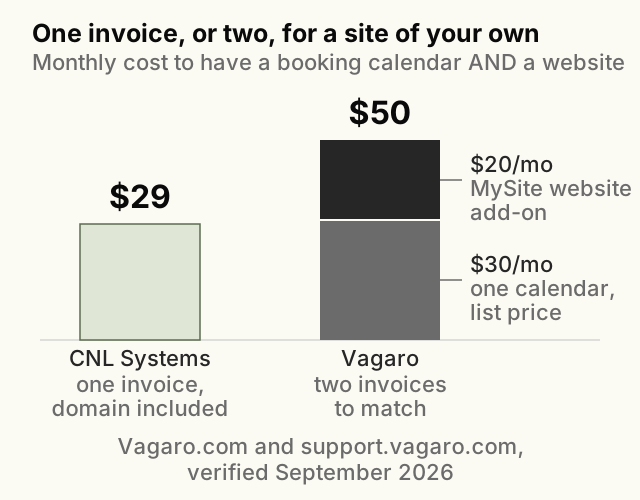
Booksy does not sell you a website at any price. You get a profile inside the Booksy app, sitting next to a "similar professionals" list of everyone else nearby who also takes Booksy bookings, which is the marketplace working exactly as designed. Square Appointments' own pricing page lists a booking site as a feature of every tier, but nowhere on that page does Square state that any tier connects a domain you own, and its own support content does not settle the question either, so this is one place we are not going to guess in your favor or theirs.
What does CNL cost a booth renter or suite owner?
$29 a month, one plan, and the website is not an add-on you discover later. It is your own domain from day one: we register a .com for you at cost, about $12 a year, or connect one you already own for free, or you can start on a free CNL subdomain and move later. Online booking comes with deposits built in, so a slot that gets booked is a slot that is likely to get kept. Payments run online and in person, reminders go out automatically, and the client list is yours: history, notes, and tags, exportable in full whenever you ask, including the day you change chairs.
There is no cut of your sales, ever. Card processing runs at Stripe's standard rates with no markup added on our end. If you want to take a card at the chair, an optional Stripe WisePOS E is $249 once, bought straight from Stripe at Stripe's own price. We do not resell it, mark it up, or sit between you and the payment.
What CNL is not: a shop management system. No staff rotas, no commission splits between chairs, no shared inventory ledger. That is correct, not a gap, because you are one renter running one book, and software built to manage a floor of six is software you would be paying for and never opening.
What the real math looks like across a month
Take a renter doing something close to 18 client visits a week at a mixed average ticket of $70, cuts, color, and the occasional package. On CNL, the month costs $29 regardless of how that revenue lands, plus Stripe's standard processing on whatever comes through the card.
Run the same month through Booksy with Boost switched on and, say, three new Boost clients booking at that $70 average: $29.99 in subscription plus three commissions at 30% of $70, or $21 each, comes to $92.99 for the month. Turn Boost off and the subscription alone is close to CNL's price, but you are back to finding your own new clients with no marketplace behind you, and you still have no website of your own.
Run it through Vagaro at the list rate with MySite attached and the month is $50 before a single booking, more than 70% higher than CNL, for a website that at least resolves on your own domain. Run it through GlossGenius Standard and the subscription undercuts CNL by a dollar at $28, but no amount of money on any GlossGenius tier buys you out of the glossgenius.com address. Square gates a no-show fee or a waitlist behind a higher tier, the same tier climb that pays for staff seats and a shared inventory ledger you do not need as a solo renter.
Booth rent is a separate number, paid to whoever owns the space, and it is real money leaving before any of this software math even starts. We are not going to invent a typical figure for it here because it varies too much by city and chair to state one honestly. Add your own number on top of whichever column above you are comparing, and the gap between a flat $29 and a stacked $50 or a per-client 30% only gets more expensive to ignore.
What to check before you sign anything
Three questions, asked in this order, before you put your name on any booking software as a renter.
- Whose account is this? If the salon owner is adding you as a calendar inside their subscription, the account, the client records, and the booking history belong to them. Ask what happens to your data on the day you leave, before you need the answer.
- Does the price include a real website, or a page on someone else's domain? A forwarded domain is not the same as an address that is actually yours. Read the vendor's own domain policy, not their marketing screenshots.
- What is the all-in cost on your actual tickets? Add the subscription, any per-seat or per-calendar fee, any website add-on, and any marketplace commission, then run it against a ticket size you actually write, not an average pulled from someone else's shop.
The short version
Booth renters get sold shop software because that is what is already running at the front desk, and shop software is built around an account the shop keeps. Booksy's Boost fee takes 30% of a first visit with a $10 floor that lands hardest on the smallest tickets a renter writes. GlossGenius will not put you on your own domain at any tier, only a forward through your registrar. Vagaro sells the actual website as a separate $20-a-month line, on top of a calendar that already costs $30. Square gates a no-show fee or a waitlist behind a higher tier, the same tier built for a floor of staff, not a single renter.
CNL is $29 a month, flat, with your own domain included from day one, deposits and reminders built in, and no cut of anything you earn. You are already running your own business from inside someone else's building. The software should know that.
Competitor prices, fees and domain policies on this page were verified at each company's own pricing pages and help centres on September 23, 2026. Prices move; check them before you sign anything, including ours.
Related guides
What booking apps cost
Booksy, GlossGenius, Vagaro, Square and CNL side by side, with every figure taken from the vendor's own published pages and dated.
Salon POS systems
Most salon POS software is priced for a retail floor with staff. What each platform charges to take a payment, and when a solo stylist is buying a register they will never open.
GlossGenius alternative
GlossGenius's advertised price and its real price are two different tiers. CNL has one plan, because nothing is being withheld.
Vagaro alternative
Vagaro sells the calendar, then sells you everything around it separately. At CNL the website is the product and $29 is the whole bill.
Booksy alternative
Booksy's marketplace works both ways. Every client who opens it to book you is browsing your competitors, and CNL puts your book on your own address.
Square Appointments alternative
Square Appointments exists to feed Square's checkout stack, and every booking page lives at a square.site address. CNL builds yours on your own domain.
Quick answers
What software should a booth renter use?
Can a booth renter just use the salon's existing booking system?
How much does booth rental booking software cost?
Is Booksy's Boost fee worth it for a booth renter?
Do GlossGenius or Vagaro give a renter their own website?
What happens to a booth renter's client list when they switch chairs?
One plan. Your domain. Live tomorrow.
$29/mo flat, everything included, and we never take a cut of your sales.
No cut of your sales · cancel anytime