§ guides
Last updated September 23, 2026POS for a beauty salon: what a solo pro actually needs
Two of the five jobs are yours. The other three are the floor's.
Search "pos for beauty salon" and the results split into two piles, and neither is built for the person typing that phrase. One pile is Square and the full-service salon suites: systems built to run a floor with several stations, a retail wall, and a shift schedule. The other is a booking marketplace that happens to process a card on the side. If you are a lash artist working out of a rented suite, a mobile brow tech, a solo esthetician, or a hairstylist who has finally outgrown Venmo and cash, you are not the customer either pile was designed around, and the feature list proves it before you ever see a price.
This page is about that gap, and about what a POS for a beauty salon actually costs once you run it against real appointments instead of a marketing headline.
What does "POS" actually mean when there's only one of you?
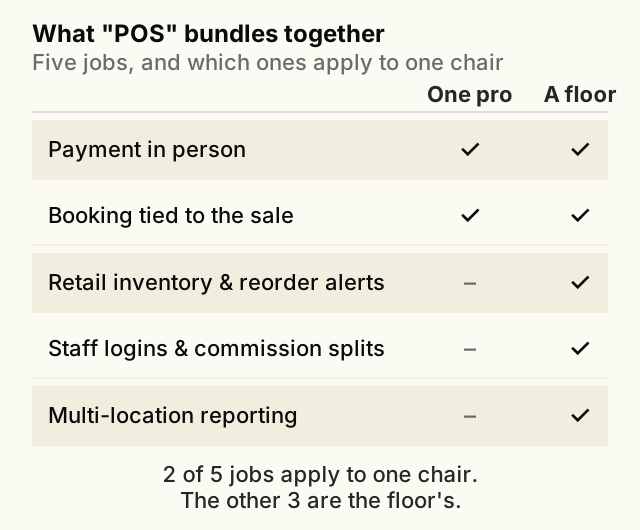
Strip the term down to what it is supposed to do at the counter, or the chair, or wherever you actually take the payment. A full point-of-sale system for a beauty business handles five jobs:
- Taking a card in person. Tap, dip, or swipe, with a tip prompt.
- Tying the payment to the booking, so a lash fill, a color, or a facial lands against the right client and the right service.
- Retail inventory, meaning stock counts, reorder alerts, and a supplier ledger for the products on your shelf.
- Staff logins and commission splits, so a shop with several people working can tell who sold what.
- Multi-location or multi-chair reporting, rolling up what several stations made in a week.
A solo beauty professional, across lashes, brows, hair, skin, and nails, needs the first two. The other three exist because a business with a floor and a payroll needs to answer questions you do not have: how much toner is left in the back, who gets credit for the upsell, what station three made compared to station one. If your business is a single calendar and a single set of hands, three of the five jobs a beauty salon POS is charging you for will sit unopened.
What a solo pro's list actually looks like instead: a booking page that takes a deposit, a reminder so the client shows, a card reader or an online charge that lands in your own account, and a record you can hand an accountant. For lash, brow, and skin services specifically, add one more: a consent form or patch-test record before a chemical or lash service, which has nothing to do with a register and everything to do with liability.
Why the top results for "pos for beauty salon" don't fit a solo pro
Read the vendors' own pricing pages and they will tell you who each tier is for, in their own words. Square's Appointments pricing page, checked today, describes its entry tier as being "for solo professionals taking payments and managing schedules," the middle tier as being "for growing teams needing more advanced tools and features," and its top tier as being "for large salons with complex staff management and booking needs." That is Square, in its own marketing copy, admitting that everything past its entry tier is aimed at a floor, not a chair.
The staff-seat pricing tells the same story from a different angle. Booksy charges $20 a month for every team member past the first. Vagaro charges $10 a month per additional calendar, up to seven. Neither fee applies to you alone on the schedule, but the base subscription was built to carry that structure, which is a large part of why the register-and-staff features cost what they cost.
What does a POS for a beauty salon actually cost at real volume?
Run the number on appointments you would actually book, not an average. Say you do 60 appointments a month, a realistic month for a solo lash, brow, hair, or skin business, at a $75 average ticket. That is $4,500 a month moving through the card reader.
| Platform | Subscription | In-person card rate | One-time fee on a client found through the platform |
|---|---|---|---|
| Fresha Independent | $19.95/mo | 2.29% + $0.20 | 20% commission, $6 minimum |
| Booksy | $29.99/mo | 2.49% + $0.10 | 30% Boost commission, $10 minimum, $100 maximum |
| GlossGenius Gold | $56/mo month-to-month | 2.6% flat | None |
| CNL Systems | $29/mo flat | Stripe's rate, 2.7% + $0.05 | None |
The subscription lines sit within about ten dollars of each other, and the in-person card rates sit within a few tenths of a percent, close enough that neither is the number worth shopping on. What actually moves is the column two of these four platforms charge on and two don't: a one-time commission on a client who found you through the platform's own marketplace rather than your own name.
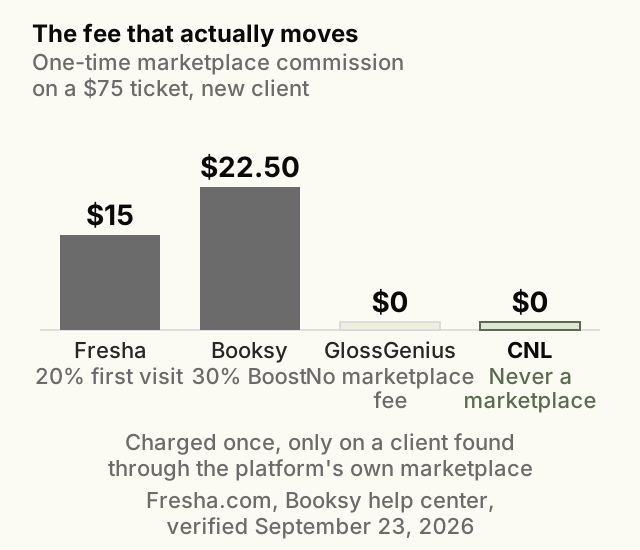
On the $75 average ticket this page is using, Fresha's 20% commission comes to $15 and Booksy's 30% Boost comes to $22.50, each charged once per new client, every time one arrives that way. Neither fee shows up on a subscription bill you can budget around; both come straight out of the ticket. GlossGenius and CNL charge neither, for different reasons: GlossGenius has no marketplace to charge it through, and CNL simply never takes a percentage of a sale.
CNL's $29 does not climb if you add a service, does not have a marketplace commission waiting behind a toggle, and is the same price whether the month is slow or the month is booked solid. Where CNL is actually built to win is everything past the sticker price, which is the rest of this page.
Do you need forms and waivers, or a stockroom?
This is the question that decides whether GlossGenius's advertised $28 or $24 a month is a real number for you or a number you will outgrow in your first month of client intake.
GlossGenius's own pricing page, checked today, shows a feature table where the Standard tier, its cheapest, does not include forms and waivers, rebooking reminders, or a waitlist. Those three live one tier up, on Gold, at $56 a month billed monthly ($48 if you prepay a year). For a hairstylist doing a straightforward cut and color, that gap might not matter. For anyone doing lash extensions, brow lamination or tinting, chemical peels, or anything else that touches a patch test or an allergy disclosure, a consent form is not optional, and Standard does not have one. The tier that actually does what a beauty business needs is Gold, not the $28 headline, and Gold is $27 a month more than CNL for features CNL includes at no extra tier.
At Vagaro, a website on your own domain is sold apart from the base calendar subscription, as a $20-a-month MySite add-on, rather than bundled into it. Square already told you, in the tier language above, which of its own tiers is built for a floor rather than a chair. Full tier breakdown: the Square Appointments alternative.
What does the hardware actually cost?
Software is only half of "point of sale." The other half is what sits in your hand or on your counter, and here the comparison is closer to even. Fresha sells reader hardware starting at $139 a device. Booksy sells a mobile Stripe Reader M2 at $53.10 plus shipping, or a countertop Stripe Reader S710 with its own touchscreen at $299 plus shipping. Vagaro includes a reader free when you sign up for its own merchant processing. CNL's optional reader is a Stripe WisePOS E, $249 once, bought directly from Stripe at Stripe's own price, with a customer-facing screen that prompts for a tip so you never have to ask out loud.
None of these are required. Every platform here, CNL included, takes online payments and deposits with no hardware at all, which covers a mobile lash or brow tech who never handles a physical card. The reader only matters once you are taking payment in person regularly, and the honest comparison is the one above: a $53 mobile reader is genuinely the cheapest hardware here, and a $299 countertop terminal is genuinely the most expensive. CNL's $249 sits closer to the top than the bottom, and it earns that with the tip screen: at one CNL salon taking payments this way, close to nine in ten payments included a tip, averaging about 17% of the service price. That is one salon's data, not a promise, but it is the reason the screen costs what it costs.
What CNL is, and is not, for a beauty pro
Said plainly, because a POS page is the wrong place to be vague. CNL is not a retail register: no stock count, no reorder alert, no supplier ledger, no staff login, no commission split. If your business genuinely runs a retail wall, sells product as a real share of revenue, or has more than one person taking payment, CNL is the wrong tool and one of the platforms above, built for that floor, is the right one.
What CNL is: your own website on your own domain, online booking with deposits, payments online and in person, automatic reminders, your client list, and email campaigns, for $29 a month, flat, one plan, no tiers to climb into and no commission on anything you sell. The domain is registered at cost, about $12 a year for a .com, or connected free if you already own one. Card processing runs at Stripe's standard rate with nothing added on top of it, the same rate used in the table above, and the optional reader is $249 once, sold by Stripe, not us.
How do you choose a POS for a beauty business?
Three questions get you to the right answer faster than any feature grid will.
- Which of the five register jobs would you actually open this year? If the honest answer is payment and booking, you are shopping for a booking system with a card reader attached, not a POS built for a floor.
- Does the entry tier you were quoted actually include what your services need? A lash, brow, or skin business needs forms and waivers. Check whether that is on the plan you were shown, or one tier up.
- What happens to the bill as you get new clients? A flat subscription and a marketplace commission behave completely differently once your book starts growing, and only one of them is predictable a year out.
The short version
Most of what ranks for "pos for beauty salon" was built to run a multi-station floor, and its own pricing pages say so in plain English if you read past the top of the page. A solo beauty pro needs two of the five jobs a real POS bundles together: taking the payment and tying it to the booking. The other three, retail inventory, staff logins, and multi-location reporting, are what the rest of the subscription is paying for.
Run the arithmetic at 60 appointments and a $75 ticket and the subscriptions and card rates sit close enough to be noise. What actually separates them is the one-time commission Fresha and Booksy each charge on a client their own marketplace found for you: 20% for Fresha, 30% for Booksy, against none at all on CNL. Add in the fact that the GlossGenius tier with forms and waivers on it costs $56, not the $28 on the homepage, and the sticker price stops being the number that matters.
CNL is $29 a month, flat, takes no cut of your sales, includes your own website on your own domain, and charges no more to add a service or take on a new client. It is not a retail register and was never built to be one. For one person doing lashes, brows, hair, skin, or nails, running the book and taking the money is the whole job, and that is what it does.
Every competitor figure on this page, including Square's tier descriptions, GlossGenius's plan prices and feature gating, Vagaro's calendar pricing, Fresha's plans, commission and processing rates, and Booksy's subscription, processing and hardware prices, was checked against that company's own pricing page or help centre on September 23, 2026. Stripe's processing rates, used only to compute CNL's own side of the arithmetic, were checked on stripe.com/pricing the same day. Prices move; check them before you sign anything, including ours.
The tipping figures are CNL payment data from one salon's card payments taken at the chair, 2026, rounded.
Related guides
Salon POS systems
Most salon POS software is priced for a retail floor with staff. What each platform charges to take a payment, and when a solo stylist is buying a register they will never open.
Barber POS systems
Most barbers shopping for a POS need a card reader and a book, not a retail register. What each platform charges to take a payment, from their own published rates.
Nail salon software
What nail salon software actually costs a solo tech, taken from each platform's own published prices, and why your own domain matters more for nails than for almost any other trade.
GlossGenius alternative
GlossGenius's advertised price and its real price are two different tiers. CNL has one plan, because nothing is being withheld.
Lash and brow booking software
What GlossGenius, Booksy, Vagaro and Fresha actually charge a solo lash or brow artist, and why a two-to-three-hour full set on a fourteen-day fill cycle needs different protection than a haircut.
What booking apps cost
Booksy, GlossGenius, Vagaro, Square and CNL side by side, with every figure taken from the vendor's own published pages and dated.
Quick answers
What is a POS for a beauty salon?
Do I need a POS system as a solo lash, brow, or nail tech?
What does a POS for a beauty salon actually cost per month?
Why do salon POS systems charge extra for staff?
Do I need forms and waivers for lash, brow, or skin services?
What does CNL charge to take a card payment?
One plan. Your domain. Live tomorrow.
$29/mo flat, everything included, and we never take a cut of your sales.
No cut of your sales · cancel anytime