§ guides
Last updated September 23, 2026Nail salon POS systems: what one chair actually needs
A card reader and a deposit, not a register
Nail work runs on a rhythm most of this category isn't built for: fills booked back to back, a full set every forty five minutes to an hour, and a shelf of thirty-odd gel colors and a couple of tubs of dip powder that turn over fast but never add up to real inventory. Search nail salon pos system, pos system for nail salon, or best pos system for nail salon and the results assume you run a floor with a front desk and a supply closet behind it. Most solo nail techs and booth renters don't. What you actually need at the table is a way to take a card, prompt for a tip without asking out loud, hold a deposit so a fill doesn't get skipped for a walk-in down the street, and keep a clean enough record to hand to whoever does your taxes. That's a shorter list than the feature grids suggest, and it's the one this page is actually about.
What does a nail POS need to do for one person?
Strip the category down to what a solo nail tech uses on a real day and it's four things.
- Take the card. Tap, dip, or swipe, with a tip prompt the client sees and answers themselves, not one you have to ask out loud.
- Hold a deposit. So a slot booked for a full set with art doesn't get walked on the morning of for a same-day opening somewhere else.
- Keep every dollar in one place. Card, cash, and Venmo landing in the same record, because a nail tech's week is often not all card, and a booth renter reporting quarterly needs the whole number, not just the half that ran through a reader.
- Hand you something to keep. A receipt for the client, and a record clean enough to hand an accountant without reconstructing a month from memory.
Everything past that (stock counts on polish bottles, reorder alerts, a supplier ledger for buffers and files, commission splits between techs sharing a station) is built for a floor with staff and a retail wall behind it. A shelf of gel colors is not an inventory operation, and a subscription tier that tracks it anyway is a tier built for a job nobody at your table needs done.
Deposits or a no-show fee: which one actually protects the chair?
Nail appointments get skipped more casually than the ticket size deserves, because a $35 fill feels low-stakes to cancel on at the last minute. Two different tools claim to fix that, and they aren't the same thing.
A no-show fee is charged after the appointment doesn't happen, against a card kept on file. Square's own pricing page lists cancellation policies and no-show fees as a feature of the Plus plan, not the entry one, so the tool meant to protect a no-show-prone chair sits behind an upgrade. And charging a card after the fact, once a client has already decided not to show, is a collections conversation as often as it's a clean transaction. They can dispute it, the card can be expired, or they can simply not answer.
A deposit is money you already have before the appointment happens. Take it at booking, on the services that actually get walked on, and skip it on the ones that don't. On CNL that's yours to set service by service, at no extra tier: put a deposit on the full set with art and leave the polish change alone. Every deposit goes to you, with no cut taken, and it's built into the $29, not an upsell that lives one plan up.
Hardware cost vs subscription: what it takes to get a reader on the table
The hardware is a one-time number, and it's smaller than the recurring stack most platforms build around it.
| Reader | Price | Sold by |
|---|---|---|
| Stripe WisePOS E (via CNL) | $249 once | Stripe, no CNL markup |
| GlossGenius Pro Reader | $299 | GlossGenius |
CNL's reader is the cheaper of the two, and it's the same kind of device: tap, dip, swipe, with a customer-facing screen that handles the tip prompt, bought straight from Stripe at Stripe's price with nothing added on our end.
Online payments need none of this. A nail tech who fills a book mostly through referrals and Instagram, not walk-ins, can take the deposit at booking, settle the balance online too, and run the whole business without ever buying a reader.
What does the card processing rate actually cost on a nail ticket?
Run each platform's own published rate against a $45 gel fill, a realistic middle ticket for a fill or a simple set. Every platform in this category lands within about ten cents of the others on a ticket this size, close enough that the rate stops being the thing to shop on. That gap is not nothing over a year of tickets, but it is not where the real money is either.
That's the honest finding here: the swipe rate barely moves. What actually separates these platforms over a real month is the subscription price and, on the one platform that runs one, a marketplace commission. Chase the wrong number and you'll optimize a ten-cent gap while missing one worth thirty percent of a ticket.
Where a 30% commission actually lands on nail-sized tickets
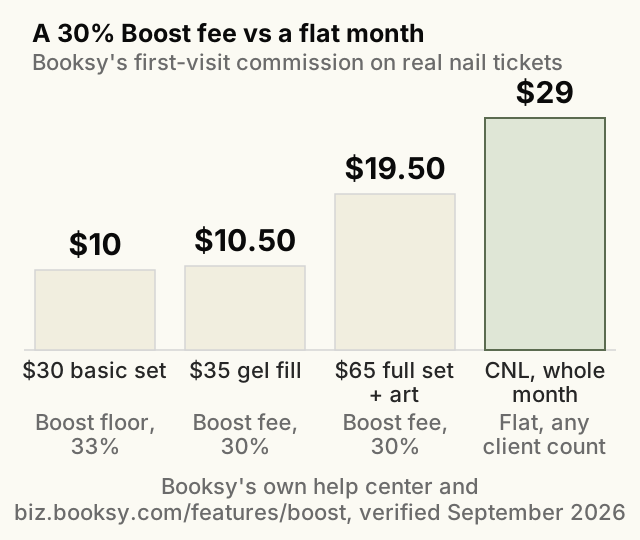
Booksy is the platform here that runs a marketplace commission on top of its $29.99-a-month subscription. Boost, its promotion tool, takes a one-time 30% of a first-time client's visit, with a $10 minimum and a $100 maximum, and tips are excluded from the cut. Run that against nail pricing instead of an average ticket and the floor does most of the damage: 30% of a $30 basic set is $9, under the $10 minimum, so the fee rounds up to $10, an effective 33%. A $35 gel fill clears the floor and comes to $10.50, exactly 30%. A $65 full set with art comes to $19.50.
Put three of those against CNL's whole month. Three new clients arriving through Boost at an average $40 ticket cost $36 in commission alone, before Booksy's own $29.99 subscription is added on top of that. CNL's entire product, deposits, reminders, your own site, your client list, and payments both online and at the chair, costs $29 for the month, no matter how many clients you see in it. A marketplace commission only makes sense at the very start, when a chair is genuinely empty and there is no other way to fill it. It's a bad deal once your book runs mostly on repeat fills and referrals, because you're paying thirty percent for an introduction that client would likely have made to you anyway.
What CNL charges to take a nail payment
$29 a month, flat, one plan. We take no percentage of your sales, ever. Card processing runs at Stripe's own published rates with no CNL markup: 2.7% plus 5 cents in person, 2.9% plus 30 cents online, the same numbers you'd get opening a Stripe account directly. The optional Stripe WisePOS E is $249 once, bought at Stripe's price, and every card payment, along with any cash or Venmo you log by hand, lands in one record with a receipt for the client and a clean total for whoever files your taxes.
The tip prompt is doing real work here, and it's our own data, not a guess. At one CNL salon taking payments at the chair, close to nine in ten card payments included a tip, averaging about 17% of the service price. That's one salon over a few dozen payments, a snapshot rather than a promise, but the pattern holds when the screen does the asking instead of you having to.
The domain is included too. We register one for you at cost, about $12 a year for a .com, or connect one you already own for free, so the address your clients rebook through has your name on it rather than a platform's.
What CNL is not
Worth saying plainly on a POS page. CNL has no stock counts, no reorder alerts on polish or dip powder, no supplier ledger, and no commission splits, because it's built for one pro running one book, not a floor with staff on it. If your shelf really is a retail operation you're tracking, or you split tips and commission with other techs at the same station, buy something built for that and skip this one. The fuller version of that argument, and what nail software should actually do instead of a register, is in nail salon software for solo techs; the same trade for a mixed hair-and-nail floor is in the salon POS guide.
How do you choose the best pos system for nail salon use?
Three questions, in the order they actually matter for a nail chair.
- Is the no-show tool a deposit or a fee? A deposit is money already collected before the appointment. A fee charged after the fact is a card-on-file argument you may not win, and on at least one platform in this comparison it also sits behind a paid tier rather than the entry one.
- What's the all-in percentage on a real ticket, not an average one? Add the card rate to any marketplace commission on top of it. A 2.6% swipe rate is noise next to a 30% Boost fee with a $10 floor on a $30 set.
- Who is the shelf actually for? If you'll never open a reorder alert or a supplier ledger, you're paying for a tier built around a floor you don't run.
The short version
A nail salon pos system built for a floor charges for stock counts and staff rotas a solo tech will never open, and the card processing rate barely moves between platforms, about fifteen cents on a $45 ticket from the cheapest to the most expensive. The number that actually changes the math is the marketplace commission: Booksy's Boost takes 30% of a first visit, with a $10 floor that lands hardest on exactly the ticket sizes nail work runs on. CNL is $29 a month flat, takes no cut of your sales ever, includes deposits at no extra tier to protect against no-shows, and pairs with an optional $249 Stripe WisePOS E, the cheapest reader of the three compared here. It's not a retail register, and for one nail tech running one chair, it was never meant to be.
Competitor processing rates and hardware prices on this page were checked against each company's own pricing and help pages on September 23, 2026: squareup.com's Appointments pricing page; glossgenius.com/pricing and its Pro Reader store page; biz.booksy.com's pricing page and its Boost feature page; vagaro.com's pricing and card-processing pages; fresha.com/pricing; and stripe.com/pricing. Booksy's $10 minimum and $100 maximum on the Boost first-visit commission were confirmed on Booksy's own help center article on how Boost pricing works, fetched September 23, 2026. Prices move; check them before you sign anything, including ours.
The tipping figures are CNL payment data from one salon's card payments taken at the chair, 2026, rounded.
Related guides
Nail salon software
What nail salon software actually costs a solo tech, taken from each platform's own published prices, and why your own domain matters more for nails than for almost any other trade.
Salon POS systems
Most salon POS software is priced for a retail floor with staff. What each platform charges to take a payment, and when a solo stylist is buying a register they will never open.
Lash and brow booking software
What GlossGenius, Booksy, Vagaro and Fresha actually charge a solo lash or brow artist, and why a two-to-three-hour full set on a fourteen-day fill cycle needs different protection than a haircut.
Booksy alternative
Booksy's marketplace works both ways. Every client who opens it to book you is browsing your competitors, and CNL puts your book on your own address.
GlossGenius alternative
GlossGenius's advertised price and its real price are two different tiers. CNL has one plan, because nothing is being withheld.
Fresha alternative
Fresha's free plan is gone. Independent is $19.95 a month, Team is $14.95 per bookable team member, and most articles written about it are out of date.
Quick answers
What does a nail salon pos system actually need to do?
Is a deposit better than a no-show fee for a nail tech?
Do card processing rates really matter when choosing a nail POS?
What does Booksy's Boost fee cost on a nail ticket?
How much is a card reader for a nail salon POS?
What does CNL charge to take a nail payment?
One plan. Your domain. Live tomorrow.
$29/mo flat, everything included, and we never take a cut of your sales.
No cut of your sales · cancel anytime